
Spider veins and varicose veins are often dismissed as cosmetic concerns, but for some patients, the problem goes well beyond appearance. Aching legs, swelling, and persistent discomfort can all point to circulation issues that deserve a closer look. Jaimes Medical Group has expert Varicose veins doctors in Chicago, IL, and has been in business since 1995.
Dr. Harold Jaimes, physician and owner of Jaimes Medical Group Varicose Vein Treatment Centers in Chicago, regularly sees patients dealing with these concerns. While some want to improve the appearance of their legs, others are looking for relief from symptoms that have developed over years of standing, working, or simply getting older.
Two patients who visited his office illustrate just how different these situations can be.
One was a 48-year-old hairstylist who had become uncomfortable wearing shorts because of visible spider veins. The other was a 63-year-old manufacturing worker whose large, bulging varicose veins were causing pain, swelling, and fatigue.
In a recent interview, Dr. Jaimes discussed both cases, explained how vein treatments have changed over the years, and answered common questions about what patients can expect.
Q: What causes spider veins, and why do some people develop them more than others?
Dr. Harold Jaimes: Genetics plays a major role, but several other factors can contribute.
One patient I treated was a 48-year-old woman who worked as a hairstylist. She spent most of her workday standing, had been through two pregnancies, and had a family history of vein problems. All of those factors can contribute to the development of spider veins.
She occasionally experienced mild leg fatigue and discomfort, but her main concern was cosmetic. She didn't like how her legs looked. That's something I see frequently. Patients become uncomfortable wearing shorts or dresses because they don't want their veins to show.
Q: How do you determine whether spider veins are cosmetic or a sign of a larger problem?
Dr. Harold Jaimes: We begin with a screening ultrasound.
Even when a patient comes in because they're unhappy with the appearance of their legs, we want to check for an underlying circulation problem. Sometimes visible veins are connected to larger veins beneath the skin that aren't functioning properly.
In this patient's case, the ultrasound showed no significant reflux, meaning blood wasn't flowing backward through the larger veins. Once we ruled that out, we knew her spider veins were a cosmetic concern. Treatment was entirely her choice.
Q: What treatment did you recommend, and what were her results?
Dr. Harold Jaimes: We treated her spider veins using sclerotherapy.
This involves injecting a solution into the affected veins, which irritates the inner walls and causes them to collapse. Some veins disappear almost immediately, while others take a month or longer to fade.
We performed her initial treatment and brought her back approximately one month later. Some veins were still visible, so we treated those areas again. By her six-month follow-up, she had achieved more than 90% clearance of the treated veins.
She was very pleased with the results and felt comfortable wearing shorts again. Most patients require between one and three sessions per leg, depending on how their veins respond. Treatment typically costs around $300 per session. We also recommend wearing compression stockings during the day for one week afterward and avoiding exercise during that period.
Q: How are varicose veins different from spider veins?
Dr. Harold Jaimes: Spider veins are generally very small, measuring about one millimeter or less in diameter.
Varicose veins are much larger, typically three millimeters or more. They're the bulging, rope-like veins that people often notice along their legs.
The difference isn't just their appearance. Larger varicose veins can be associated with chronic venous insufficiency, which occurs when blood flows backward through veins instead of returning properly toward the heart. That can lead to symptoms such as aching, swelling, heaviness, and fatigue.
Q: Can you share an example of a patient who needed treatment for varicose veins?
Dr. Harold Jaimes: I treated a 63-year-old man who had worked in manufacturing for decades.
He spent long hours standing and had developed large, bulging veins in his legs. He also had a family history of vein problems, excess body weight, and age-related factors contributing to his condition. By the time he came to see me, he was experiencing heaviness, aching, swelling around his ankles, and fatigue.
We performed an ultrasound, which showed that blood was flowing backward through some of his larger veins. We initially prescribed compression stockings to help improve circulation, but his symptoms continued because of how advanced the condition had become. At that point, we determined he would benefit from a procedure.
Q: What procedure did you perform, and how did it help?
Dr. Harold Jaimes: We performed endovenous laser ablation.
It's a minimally invasive procedure that allows us to close the affected vein without making a surgical incision. We insert a thin laser fiber into the vein through a needle puncture. The laser heats the inside of the vessel, causing it to close. Once the vein closes, blood redirects through healthier veins. The procedure takes approximately 20 minutes and is performed in the office using local anesthesia.
For this patient, the treatment successfully closed the affected vein. He reported significantly less pain, swelling, and discomfort afterward. One thing patients commonly tell me is that their legs feel lighter after treatment.
He was able to return to his usual non-strenuous activities shortly after the procedure while wearing compression stockings. We recommend avoiding exercise for two weeks. By approximately one month afterward, he had started exercising again and was feeling considerably better.
Q: Can varicose veins return after treatment?
Dr. Harold Jaimes: Recurrence in a treated vein is possible, but it's uncommon with the procedures available today.
I estimate the recurrence rate at approximately 1%. However, other veins can develop problems later. Someone may have one vein successfully treated and eventually experience reflux in another vein. That's why follow-up appointments are important. I generally recommend patients return after a year or two unless they begin experiencing symptoms sooner.
Q: What happens if someone leaves painful varicose veins untreated?
Dr. Harold Jaimes: Chronic venous insufficiency can progress over time.
Patients may initially experience aching, heaviness, tingling, numbness, or swelling. As the condition progresses, poor circulation can begin affecting the skin. We may see discoloration, inflammation, dermatitis, or staining around the affected areas.
In more advanced cases, patients can develop leg ulcers, which are wounds that have difficulty healing. Not everyone will experience these complications, but they're among the reasons persistent symptoms shouldn't be ignored.
Q: Are there risks associated with vein treatments?
Dr. Harold Jaimes: All medical procedures carry some risk.
The most common side effects of vein treatments include minor redness, tenderness, and bruising. These generally resolve on their own. More serious complications are possible, although they're rare.
One concern is a blood clot forming in a deeper vein and potentially traveling to the lungs, causing a pulmonary embolism. I estimate the possibility of this type of serious complication at approximately 1%, and fortunately, I haven't encountered one in my practice.
Q: What can people do to reduce their chances of developing vein problems?
Dr. Harold Jaimes: I'm a strong advocate for prevention.
Compression stockings are one of the things I recommend most often, particularly for people who spend long periods standing or sitting. I also recommend them during extended travel, including long flights and car rides.
Regular physical activity and maintaining a healthy body weight can help. Excess body weight increases pressure within the abdomen, which can affect circulation through the larger veins and contribute to varicose veins.
I also encourage patients to maintain a healthy diet and avoid smoking and excessive alcohol consumption. Genetics and age aren't things we can change, but there are steps people can take to help reduce some of the contributing factors.
Q: What would you tell someone who's nervous about having their veins examined?
Dr. Harold Jaimes: I would encourage them to get screened rather than avoid an appointment because they're worried about treatment.
Some people still associate vein procedures with traditional vein stripping, which was considerably more invasive. The treatments available today are very different.
Many procedures are minimally invasive, performed in an office, and allow patients to return to their normal non-strenuous activities quickly. An ultrasound screening is painless and noninvasive. It gives us valuable information about what's happening beneath the skin.
Not everyone who comes in needs a procedure. Sometimes compression stockings and preventive measures are all that's recommended. The important thing is understanding what's causing the problem before deciding what to do next.
About Jaimes Medical Group Varicose Vein Treatment Centers
Jaimes Medical Group Varicose Vein Treatment Centers is located in Chicago, Illinois, and provides evaluation and treatment for patients experiencing spider veins, varicose veins, and related circulation concerns.
Led by physician and owner Dr. Harold Jaimes, the practice offers ultrasound screening and treatment options that include sclerotherapy and endovenous laser ablation. Treatment recommendations depend on the patient's symptoms, examination findings, and whether an underlying circulation problem is present.
Business Name: Jaimes Medical Group Varicose Vein Treatment Centers
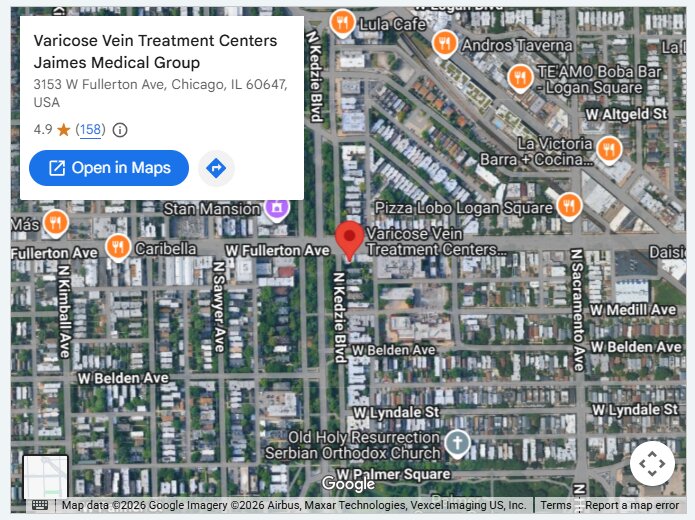
Address: 3153 W Fullerton Ave, Chicago, IL 60647
Phone Number: 773-974-6693
###
Contact
Jaimes Medical Group Varicose Vein Treatment Centers
Dr. Harold Jaimes, Physician and Owner
773-974-6693
[email protected]
https://www.jaimesmedicalgroup.com/ambulatory-phlebectomy/
Disclaimer: This press release is provided for general informational purposes only and is not intended as medical advice, diagnosis, or a substitute for consultation with a qualified healthcare professional. Individual treatment recommendations, risks, recovery times, and results vary based on each patient's condition and other factors. The patient experiences described are individual cases and are not a guarantee or indication that other patients will achieve the same or similar results. Patients should consult a qualified healthcare professional regarding their symptoms and appropriate treatment options.
Source: 38 Digital Market News
Release ID: 2768924



